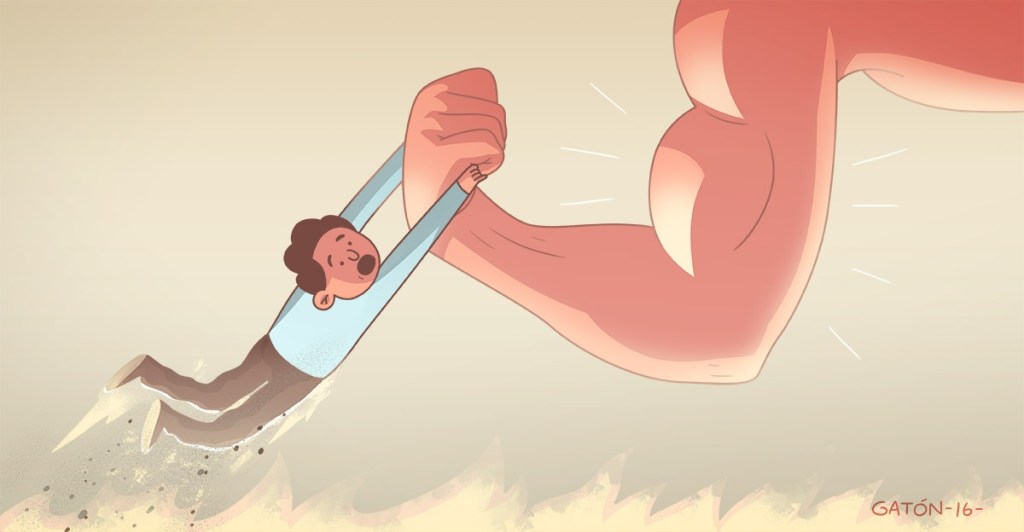
The world is increasingly designed to depress us. Happiness isn’t very good for the economy. If we were happy with what we had, why would we need more?.
How do you sell an anti-ageing moisturiser? You make someone worry about ageing. How do you get people to vote for a political party? You make them worry about immigration. How do you get them to buy insurance? By making them worry about everything. How do you get them to have plastic surgery? By highlighting their physical flaws. How do you get them to watch a TV show? By making them worry about missing out. How do you get them to buy a new smartphone? By making them feel like they are being left behind.
To be calm becomes a kind of revolutionary act. To be happy with your own non upgraded existence. To be comfortable with our messy, human selves, would not be good for business.

✍️ Matt Haig.
REFLECTION.
The statement "the world is increasingly designed to depress us" suggests that current social and economic structures, especially those related to consumerism, foster unhappiness to boost economic activity. If people were satisfied with what they have, the need to buy more would decrease, negatively affecting economic growth.

This idea can be broken down into several points:

Consumerism and obsolescence:
It is argued that companies constantly create new needs and desires, often through advertising, so that people feel the need to buy new products, even if the ones they already have work well.

Social comparison:
Social media and the media often depict idealized lives, which can lead people to compare themselves with others and feel dissatisfied with their own lives.

Happiness as a commodity:
It is argued that happiness has become a product that can be purchased, whether through material goods, experiences, or services, and that companies profit from this pursuit of happiness.

The contrast with economics:
The idea that happiness is not good for the economy implies that a prosperous market depends on dissatisfaction and a constant desire for improvement.

In short, the phrase criticizes the idea that economic growth and social well-being go hand in hand, suggesting that the current system prioritizes economic growth at the expense of individual well-being and happiness.
Pixabay.
El mundo está cada vez más diseñado para deprimirnos. La felicidad no es muy buena para la economía. Si estuviéramos contentos con lo que tenemos, ¿para qué necesitaríamos más?
¿Cómo se vende una crema hidratante antiedad? Se preocupa a alguien por el envejecimiento. ¿Cómo se consigue que la gente vote por un partido político? Se preocupa por la inmigración. ¿Cómo se consigue que compren un seguro? Haciéndoles preocuparse por todo. ¿Cómo se consigue que se hagan una cirugía plástica? Destacando sus defectos físicos. ¿Cómo se consigue que vean una serie de televisión? Haciéndoles preocuparse por perderse algo. ¿Cómo se consigue que compren un nuevo smartphone? Haciéndoles sentir que se les está dejando atrás.
Estar tranquilo se convierte en una especie de acto revolucionario. Ser feliz con una existencia sin actualizar. Estar cómodos con nuestro yo humano y desordenado no sería bueno para el negocio.


✍️ Matt Haig.
REFLEXIÓN.
La afirmación "el mundo está cada vez más diseñado para deprimirnos" sugiere que las estructuras sociales y económicas actuales, especialmente las relacionadas con el consumismo, fomentan la infelicidad para impulsar la actividad económica.

Si la gente estuviera satisfecha con lo que tiene, la necesidad de comprar más disminuiría, afectando negativamente al crecimiento económico.

Esta idea se puede desglosar en varios puntos:

Consumismo y obsolescencia:
Se argumenta que las empresas crean constantemente nuevas necesidades y deseos, a menudo a través de la publicidad, para que la gente sienta la necesidad de comprar productos nuevos, incluso si los que ya tienen funcionan bien.

Comparación social:
Las redes sociales y los medios de comunicación a menudo muestran vidas idealizadas, lo que puede llevar a las personas a compararse con los demás y sentirse insatisfechas con sus propias vidas.

Felicidad como producto:
Se plantea que la felicidad se ha convertido en un producto que se puede comprar, ya sea a través de bienes materiales, experiencias o servicios, y que las empresas se benefician de esta búsqueda de felicidad.

El contraste con la economía:
La idea de que la felicidad no es buena para la economía implica que un mercado próspero depende de la insatisfacción y el deseo constante de mejora.

En resumen, la frase critica la idea de que el crecimiento económico y el bienestar social van de la mano, sugiriendo que el sistema actual prioriza el crecimiento económico a expensas del bienestar individual y la felicidad.
So good, so true. Keep on going, keep on discovering. You are a beautiful soul who uses her sensitivity for good to help others. I’m proud to know you, I’m proud to be a part of your writings. Be blessed, God is with you always.
Excellent post. I remember years ago someone asked me why, when TV crews go into remote villages, the people look so happy? “They have nothing, no electricity, gas, cars, nothing we have?”
I said, “If you have nothing, you have nothing to lose.” 🤔 Love your thinking on this 👍
What an insightful way to look at the deceptions of mankind! You’ve expound it so well I could see how my flaws have been turned into a marketing strategy by others. Amazing 👏
Good post, highlighting how companies capitalize on our lack of contentment! The Apostle Paul wrote in the Bible, «I have learned to be content whatever the circumstances.» When we learn that «secret,» we can resist the attempts of those who try to make us feel dissatisfied.
“Being at peace in a world built on fear… that truly is revolutionary.”
Matt Haig’s words pierce through the noise of modern life with unsettling accuracy. We’re constantly told we’re incomplete—so we consume, compare, and chase endlessly.
But maybe the quietest, boldest rebellion is this: to stop chasing.
To breathe.
To say “I am enough, just as I am.”
Thank you for reminding us that inner stillness is not weakness—but strength in its purest form.
Es cierto que, en muchas ocasiones, se crea una necesidad allá donde no existe, todo ello encaminado a la venta de un producto o la prestación de un servicio que en buena parte puede resultar superfluo. Nos corresponde a nosotros mantener un espíritu crítico para seleccionar aquellas pocas novedades que sí nos puedan resultar beneficiosas y rechazar las demás.
Gracias por compartir este aleccionador pensamiento.
Capitalism and Consumerism at their finest, hand-in-hand, manipulating the masses. It’s very sad to see so many fall for the trap. Thank you for your post and subscribing to mine 🙂
Yes…I need an anti-aging moisturiser desperately looking at the state of our world 😭. Everyone needs to play their role (no matter how small) to reduce plastic pollution as a start! ✌️🌎
My grandparents were happy because they could afford appliances that would «last forever». I feel like people today buy something nice and then it is outdated the next year-creating a sense of need to get the most updated version. Progress is good, but when does it become toxic? Probably when we lose happiness and a sense of stability.
Thank you for your like. Because in my WordPress reader/user account, post titles always remain. safiadigitaltechandwellnes.com And the prompt topic is my blog post; if you click “read more,” it will redirect to my blog, and if you click my title, it will redirect to my website. Kindly read my entire post each time, as that will be a great help to me. If you also leave a comment, I would be even more grateful to you.
I love anything Matt Haig writes and totally agree with your post. Capitalism ever hones their fear-mongering marketing and I believe that, even apart from actual politics and such as topics, has made us all much more emotional, easier to antagonize and to trigger us into extreme actions.
The system create anxiety, worry and uncertainty. We need to learn to find peace everyday while dealing with daily challenges. Thank you for reminding us that we should take care of what we focus on.
This text makes some interesting points. It suggests a direct link between modern consumerism and manufactured anxiety. The author argues that our economy thrives on making us feel inadequate. It’s a different way to look at why we always feel the need for something more. The idea that being calm is a «revolutionary act» is powerful. The author, Matt Haig, is a well-known writer, and his words often resonate with many people.
Specific and engaging: «You’re very welcome! The idea that being calm is a ‘revolutionary act’ is something that really stuck with me. Thanks for sharing your perspective.»
I’m Bedrock. Discover the ultimate Minetest resource – your go-to guide for expert tutorials, stunning mods, and exclusive stories. Elevate your game with insider knowledge and tips from seasoned Minetest enthusiasts.






 PK 🌎
PK 🌎 
Replica a Aqueronte72 Cancelar la respuesta