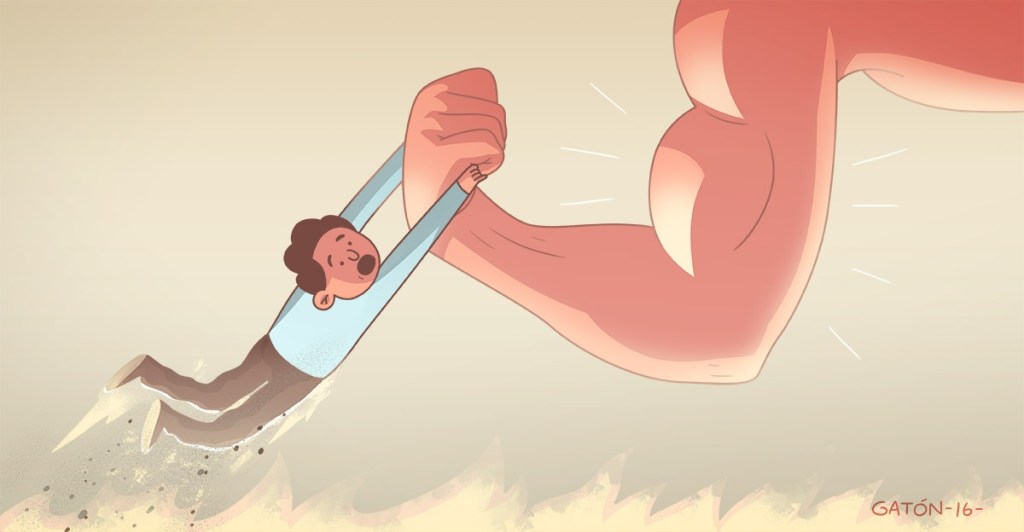
The world is increasingly designed to depress us. Happiness isn’t very good for the economy. If we were happy with what we had, why would we need more?.
How do you sell an anti-ageing moisturiser? You make someone worry about ageing. How do you get people to vote for a political party? You make them worry about immigration. How do you get them to buy insurance? By making them worry about everything. How do you get them to have plastic surgery? By highlighting their physical flaws. How do you get them to watch a TV show? By making them worry about missing out. How do you get them to buy a new smartphone? By making them feel like they are being left behind.
To be calm becomes a kind of revolutionary act. To be happy with your own non upgraded existence. To be comfortable with our messy, human selves, would not be good for business.

✍️ Matt Haig.
REFLECTION.
The statement "the world is increasingly designed to depress us" suggests that current social and economic structures, especially those related to consumerism, foster unhappiness to boost economic activity. If people were satisfied with what they have, the need to buy more would decrease, negatively affecting economic growth.

This idea can be broken down into several points:

Consumerism and obsolescence:
It is argued that companies constantly create new needs and desires, often through advertising, so that people feel the need to buy new products, even if the ones they already have work well.

Social comparison:
Social media and the media often depict idealized lives, which can lead people to compare themselves with others and feel dissatisfied with their own lives.

Happiness as a commodity:
It is argued that happiness has become a product that can be purchased, whether through material goods, experiences, or services, and that companies profit from this pursuit of happiness.

The contrast with economics:
The idea that happiness is not good for the economy implies that a prosperous market depends on dissatisfaction and a constant desire for improvement.

In short, the phrase criticizes the idea that economic growth and social well-being go hand in hand, suggesting that the current system prioritizes economic growth at the expense of individual well-being and happiness.
Pixabay.
El mundo está cada vez más diseñado para deprimirnos. La felicidad no es muy buena para la economía. Si estuviéramos contentos con lo que tenemos, ¿para qué necesitaríamos más?
¿Cómo se vende una crema hidratante antiedad? Se preocupa a alguien por el envejecimiento. ¿Cómo se consigue que la gente vote por un partido político? Se preocupa por la inmigración. ¿Cómo se consigue que compren un seguro? Haciéndoles preocuparse por todo. ¿Cómo se consigue que se hagan una cirugía plástica? Destacando sus defectos físicos. ¿Cómo se consigue que vean una serie de televisión? Haciéndoles preocuparse por perderse algo. ¿Cómo se consigue que compren un nuevo smartphone? Haciéndoles sentir que se les está dejando atrás.
Estar tranquilo se convierte en una especie de acto revolucionario. Ser feliz con una existencia sin actualizar. Estar cómodos con nuestro yo humano y desordenado no sería bueno para el negocio.


✍️ Matt Haig.
REFLEXIÓN.
La afirmación "el mundo está cada vez más diseñado para deprimirnos" sugiere que las estructuras sociales y económicas actuales, especialmente las relacionadas con el consumismo, fomentan la infelicidad para impulsar la actividad económica.

Si la gente estuviera satisfecha con lo que tiene, la necesidad de comprar más disminuiría, afectando negativamente al crecimiento económico.

Esta idea se puede desglosar en varios puntos:

Consumismo y obsolescencia:
Se argumenta que las empresas crean constantemente nuevas necesidades y deseos, a menudo a través de la publicidad, para que la gente sienta la necesidad de comprar productos nuevos, incluso si los que ya tienen funcionan bien.

Comparación social:
Las redes sociales y los medios de comunicación a menudo muestran vidas idealizadas, lo que puede llevar a las personas a compararse con los demás y sentirse insatisfechas con sus propias vidas.

Felicidad como producto:
Se plantea que la felicidad se ha convertido en un producto que se puede comprar, ya sea a través de bienes materiales, experiencias o servicios, y que las empresas se benefician de esta búsqueda de felicidad.

El contraste con la economía:
La idea de que la felicidad no es buena para la economía implica que un mercado próspero depende de la insatisfacción y el deseo constante de mejora.

En resumen, la frase critica la idea de que el crecimiento económico y el bienestar social van de la mano, sugiriendo que el sistema actual prioriza el crecimiento económico a expensas del bienestar individual y la felicidad.
It seems so. He may be trying to pretend that he doesn’t want to be happy. I just hope that innocent and good people don’t get demoralized by this kind of posts. Thanks.
Again, it was a very nice article. My friend. The articles are very informative. The world has turned people into a spectacle. We now live in show business.
💯🫂👍🥰
Have been contemplating writing on this subject for some time. In a world meticulously crafted to sow discontent, your words resonate deeply. The truth laid bare is uncomfortable yet undeniable – our desires are skillfully manipulated to drive an insatiable economic machine. The quest for perpetual growth hinges on our perpetual dissatisfaction.
Yet, amidst this manufactured chaos, a sobering realization emerges. We, the consumers, are not just passive victims of this orchestrated discontent; we are active participants. We willingly succumb to the whispers of inadequacy, perpetually chasing the next upgrade, the next enhancement, the next fix for our perceived flaws.
Your poignant observations prompt introspection. It is we who fan the flames of our discontent, willingly surrendering to the allure of unattainable ideals. The commodification of our insecurities is a reflection of our collective weakness – the inability to find contentment in our unaltered, imperfect selves.
Perhaps, in acknowledging our complicity, lies the seed of revolution. To resist the constant push for more, to find calm in simplicity, and to be content with our un-upgraded existence becomes an act of rebellion. It’s a conscious choice to reject the manufactured urgency to constantly improve, to upgrade, to consume.
Your insight begs the question: What if we were to defy the narrative? What if we were to embrace gratitude for what we have, rather than resenting what we lack? It’s a paradigm shift – a shift from perpetual dissatisfaction to a mindful appreciation for the present.
Let us, as individuals, challenge the status quo. Let us recognize that our pursuit of contentment need not be dictated by external forces. In choosing gratitude over complaint, we reclaim agency over our happiness. The power to disrupt the cycle of discontent lies within us, waiting to be awakened by the revolutionary act of being truly content with our imperfect, un-upgraded selves.
You visited my site and left a nice message so I wanted to visit yours and look at your content. I just had Google translate this English and now I can read it!
What this describes is market driven economies backed by huge conglomerates who have some measure of control on what we see (TV, news, internet, media in general) and then package their product attractively to the 5% who act on their gut impulses, and then that 5% gets to represent the ‘norm’ in societal circles by the clothes they wear, the food they eat, the medications they take, hell, even the vacations we should take.
Don’t be woke, be yourself.
You are correct in the world of business and are promoting lifelong hassle of rollercoaster rides of unsatisfied goals. Life is not business Mr. Matt. Business is a part of life. And if you become a fan of materialistic objects, you’ll miss life and happiness, and at the end get a bad taste in mouth. So, I advise you to be careful and learn to live life earnestly and not just be a fan of business and money. Thanks.
I’m sure PK mundo, you understand me. You articles are usually very helpful and support virtues and values. This time it surprised me that you are posting a contrary content.
Well, happiness has nothing to do with expensive goods. It is about good memories that you make and cherish and which has wellbeing for both parties as it inner intentions. Hope you find this information useful and helps in adding happiness to your life and others in the comments section. Thank you.
Interesting blog post! 🧐 People want more stuff,💭 the latest iPhone, 📱 Gucci bag,💼 Ferrari etc because it momentarily covers up the way they feel about themselves.
Nothing can change the sense of lack apart from the joy of being in the present moment.
Thanks for sharing PK 😃
I’m Bedrock. Discover the ultimate Minetest resource – your go-to guide for expert tutorials, stunning mods, and exclusive stories. Elevate your game with insider knowledge and tips from seasoned Minetest enthusiasts.






 PK 🌎
PK 🌎 
Replica a A BETTER 🌎 (pk 🌎) Cancelar la respuesta